Sunday, 3 September 2006
Pdf's for some articles

Many people (including me) have problems viewing the Chinese characters on my site. Even Firefox, which is the best browser for it, does not always do the job right. To help visitors viewing the articles I have converted some of them to pdf format, which can be viewed with Acrobat Reader. If you see this icon

at the beginning of an article, you can view that article as a pdf by clicking on the icon. Disadvantage of these pdfs is that you cannot click links, or images for enlargment. So keep it alongside with the original web article and you should do fine.
Wednesday, 30 August 2006
Hexagram 2 in a Yijing fragment of the Xiping Stone Classics

 Volume 3 of the Gushi Bian 古史辨 (ISBN 5550110350), which contains the famous articles by Gu Jiegang 顧頡剛 (1893-1980), also has a small article by Ma Heng 馬衡 (1881-1955), titled 漢熹平石經周易殘字跋, 'Annotations of the remnant characters in the Zhouyi Stone Classic from the Han dynasty Xiping period' (p. 70-73). The article deals with the variant characters that are found on a stone fragment of the Yijing text that was engraved in stone in 175 AD (not 180 BC as is said here; image from Gushi Bian 古史辨, vol. 3, p. 70/71, click to enlarge).
In his book Warp & Weft - In search of the I-Ching, William de Fancourt tells about the making of these Stone Classics (ISBN 1861630069, p. 100):
(...) Chinese scholars searched for definitive versions of the texts elevated to the status of jing in 136BCE, and attempted literally to cast them in tablets of stone.
The first attempt was begun in the year 175CE, during the latter part of the Han dynasty. This great project took some eight years to complete. When finished, the stone classics were erected at the Imperial Academy in Luoyang. Thousands flocked to see them and make rubbings, much like those of brass monuments in old churches today. In fact, the stone classics became such an enormous attraction that a guard had to be posted around them to control the crowds.
Shortly after their completion, these stone stelae were badly damaged in the year 190CE, during the political upheaval that marked the end of the Han dynasty. Unfortunately, only fragments and rubbings of them survive today.
The surviving shattered fragments of these stone tablets, and antique rubbings of lost pieces, include only 1,171 characters of the total 24,437 characters of the modern Yijing. (...) Though incomplete, they are sufficient to piece together a text which bears a closer resemblance to today's Yijing than does the Mawang Dui manuscript.
Stuart V. Aque quotes Zhou Yutong's commentary to Pi Xirui 皮錫瑞 (1850-1908) his Jingxue lishi 經學歷史 in his dissertation Pi Xirui and Jingxue lishi (p. 589, n. 108; see also p. 697-703):
The "Biography of Cai Yong" 蔡邕傳 chapter of the Hou Han shu states, "In 175 A.D., the fourth year of the Xiping 熹平 period (172- 177)...a memorial was submitted to the emperor which sought to correct and determine in a fixed form the characters of the Six Classics. Emperor Ling 靈帝 (reg. 168-189) consented to it. Cai Yong then wrote the characters in red on a stone slab, and had artisans then chisel and carve the characters. The stones were then placed in an upright position outside of the gate of the Imperial Academy." (...) These are none other than what is referred to as the Xiping Stone Classics, and are also called the Han Stone Classics. Xiping is a reign period (172-77) of Emperor Ling and the fourth year of the Xiping period is 175 A.D.--[the year they were finished].
 One side of the fragment that Ma discusses contains parts of the texts of hexagram 37 to hexagram 54; the other side contains fragments of the Wenyan and Shuogua chapters of the Ten Wings. Even though it's a small fragment Ma recognizes quite some differences with the received text of the Yijing. I will not discuss all these differences (unless by popular demand), there is one variant character I would like to bring forward. In chapter four of the Shuogua there is the line '坤以藏之'. This line is also found on the stone fragment, but the character 坤 (the name of hexagram 2 in the standard edition of the Yijing) is replaced by
 . It is the same character that is found in the Mawangdui version of the Yijing: chuan 川.
 When I read this my first reaction was "this is interesting!". But during my research of the origin, history and language of the Stone Classics, and the usage of this specific character, it turned out not to be so spectacular. Often the character 川 is translated as 'flow' (Shaughnessy), 'waterway' or something similar, but you might seriously doubt if this is a correct translation in the given context. Yes, 川 means 'stream' or 'flow', but on many stone tablets from the Han dynasty 川 is used as a substitute for 坤 (Wu Xinchu 吳新楚, "Zhouyi" yiwen jiaozheng 《周易》异文校证, ISBN 7218037194; p. 38). The Li Bian 隸辨, a dictionary of characters from Han stone tablets which was compiled by Gu Aiji 顧藹吉 in 1718, lists five of these cases (ISBN 7101041442; p. 38-39. See image on the left; click to enlarge. Picture from Dictionary of Chinese Character Variants). In the Dictionary of Chinese Character Variants 川 is listed under 坤. Tang dynasty scholar Lu Deming
陸德明 (556-627) says in his Zhouyi Shiwen 周易釋文 about 坤 (古史辨, vol. 3, p. 73):
本又作
,
Also written as
(For the phrase 今字 meaning 'Lishu style of writing from the Han dynasty' see 漢語大詞典 1.1079-B).

 But there is more. The variant characters of 川, namely 巛, 𡿦 and 𡿭, are also long known substitutes for 坤 (漢語大字典 2.1097). If you rotate these variant characters 90° CW they turn into the trigram Earth (see also Deng Qiubo 邓球柏, Boshu Zhouyi jiaoshi 帛书周易校释, ISBN 7543812975; p. 260). Well, maybe not the first one, but the other two do. The characters 𡿦 and 𡿭 could be two ways of writing the trigram. Because 巛 and 𡿦 are very similar it is easy to mix them up, and therefore I believe that hexagram 2 was never meant to be named 巛 with the meaning of 'stream', or 'flow', but instead 𡿦 was originally intended, as an alternative form of the trigrams that form the hexagram.
Summarizing: the character 川 and its variants 巛, 𡿦 and 𡿭 were during the Han dynasty (206 BC–AD 220) well-known substitutes for 坤. To me this indicates that hexagram 2 was not meant to be named 'stream', flow', or 'waterway' or similar names. For the meaning of the name of hexagram 2 we can only rely on the Shuogua, which says that Kun stands for 'earth' (chapter 11). Because the earliest appearance of the character 坤 is found in the Yijing, and all other instances of it in later books are references to the Yi, it is hard to find the original meaning without the aid of commentaries like the Ten Wings.
Tuesday, 29 August 2006
The panther change of the junzi

A few months ago someone asked me what the panther change in the sixth line of hexagram 49 might refer to. This is what I answered him:
It seems to be an age old fixed expression, and to find out what it
refers to we have to look at the context. The Yi says
君子豹變.小人革面.
There is rhyme in these two sentences: Jūnzǐ bàobiàn.
Xiǎorén gémiàn, and they obviously belong to each other like
yin & yang. "The junzi changes like a panther. The small person changes his face." What the small person does is (more or less) bad, what
the junzi does is good. Baobian, a panther/leopard
change, seems to be good. The Hanyu Da Cidian says about 豹變:
-
謂如豹文那樣發生顯著的變化。幼豹長大退毛,然後疏朗煥散,其毛光澤有文采。
Said when the markings on a leopard distinctively change. When a young leopard grows up he depilates, after that shiny [spots] appear and his fur gets glossy with rich and bright colors. -
喻人的行為變好或勢位顯貴。
A metaphor used when a person reforms his action or obtains an eminent place of power.
Baobian is an improvement for the better. Gemian 革面 however, is not:
-
謂改變臉色或態度
Said when one changes his facial expression or attitude. -
比喻徹底悔改
Metaphor for thorough repent and reform (But this is a relatively young meaning of gemian, only used since the Jin Dynasty HM) -
用皮革做的面子
Name for the outside of leather.
I think that in the Yi the first meaning is meant. Baobian is a transformation which takes place in one's nature, it cannot be controlled, it has to take it's natural course. Gemian is a change only in the face, the outside expression which can be controlled by ones will and intentions. Follow nature is good, follow the will is not good. Therefore 征凶.居貞吉. A (planned, will-driven) journey would not do any good. Stay put and perform the divination at one's own place (that is where nature is) is good.
Monday, 28 August 2006
Irian's vacation quotes
Ik vind de naakten erg mooi.

 "I find the nudes very beautiful." Said when looking at the pictures in a catalogue of paintings by Fernando Botero, in a museum in Vledder. The Dutch word 'naakten' is a more or less decent or polite word for naked people, you would not expect it to be used by a child who is six years old. Most children would use the word 'bloot'.
Harmen, je kan het niet zien, maar elke keer als ik een nieuwe vriend krijg wordt mijn hart een beetje groter.
"Harmen, you can't see it, but everytime I get a new friend my heart gets a little bigger."
Wednesday, 19 July 2006
The Shang Cemetery in Google Earth
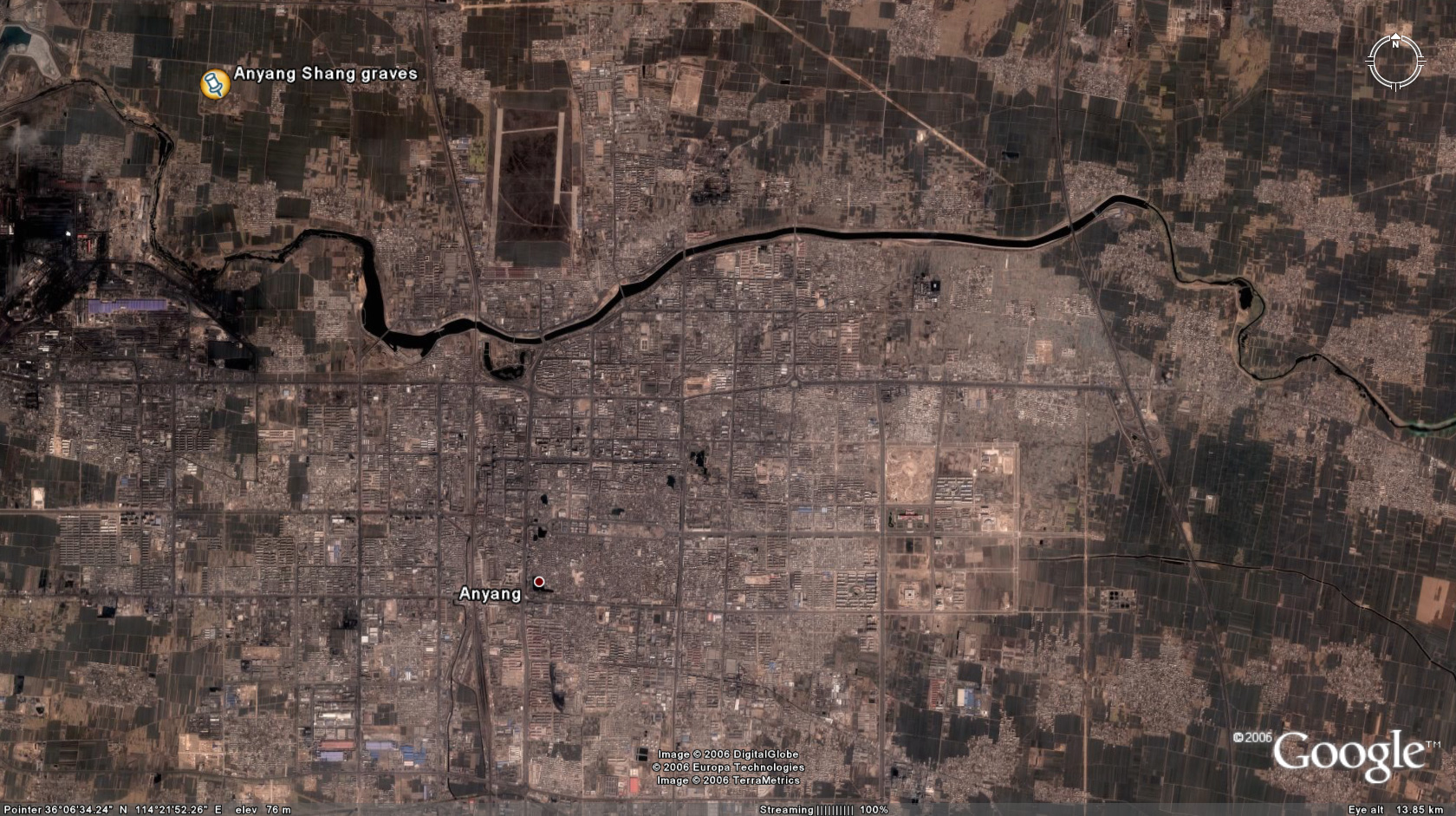
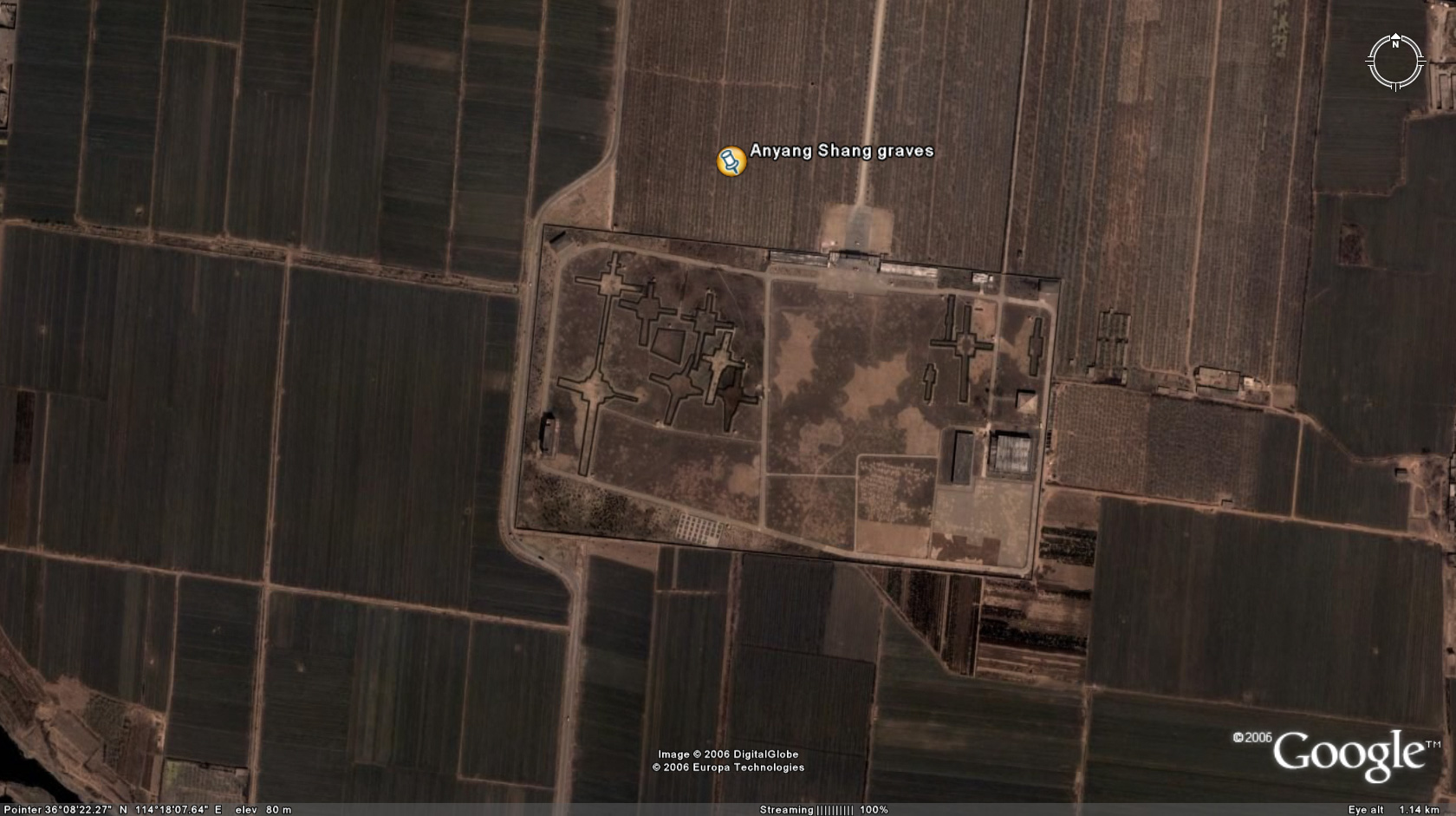
If you have Google Earth you can click this placemark to fly to Anyang.
Wednesday, 5 July 2006
The remarkable deductions in 'xiangshu' explanations
九四為外互坎之中爻. 後天象坎在正北. 於十二辰為子. 子之肖生鼠。而居大臣之位。是鼠之大者也. 故曰鼫鼠. (...) 貪殘畏人如鼫鼠. 雖欲持祿保位.
The fourth line is the middle line of the outer nuclear trigram Kan 坎. As a Houtian 後天 image Kan belongs to the true North. In the Twelve Hours this corresponds with hour zi 子. Hour zi resembles the (Chinese sign) Rat. Furthermore, the fourth line resides at the position of a high official. This is the 'great' of the rat. Therefore it is said 鼫鼠, 'large rat'. (...) Corrupted, greedy and fearing people are resembled by the large rat. They only desire to maintain there position without achieving anything.
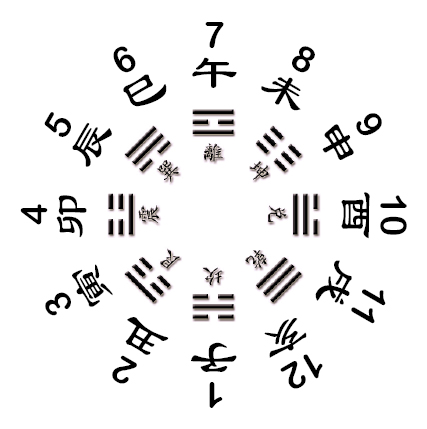
Huang does not explain how the Zhouyi can use the system of the Chinese zodiac which was introduced in China centuries after its composition. His thoughts are amusing, but hardly convincing. Chung Wu bluntly copied Huang's ideas in his The Essentials of the Yi Jing without questioning if they were valid (p. 333). It shows that copying is easier than thinking.
Tuesday, 20 June 2006
The mole cricket
The shishu 鼫鼠 animal in the fourth line of hexagram 35 is most often recognized as some sort of rat, mouse or hamster. Even in old China there was speculation about the true meaning of this word: what animal did the author(s) of the Zhouyi refer to? The word 鼫鼠 is quite rare, we hardly find it in other old books. But the Mawangdui Yijing might help us to find the meaning that the authors intended.
The first character 鼫 is very often substituted by 碩, and the word 碩鼠 is much more common. In fact, in the Harvard-Yenching edition of the Yijing we find 碩鼠 instead of 鼫鼠. [Update 25-6: Steve Marshall informed me that the original 1935 printed edition of the Harvard-Yenching edition (which I do not have) does not use 碩, just as most - if not all - Yijing editions it uses 鼫. However, it does contain a footnote which says "鼫一作碩", "鼫 is also written as 碩". It seems they applied this footnote in their electronic version of the text.]
In the Shijing 詩經 there is a poem (M113) in which the animal plays an important role:
碩鼠碩鼠、無食我黍.
Most translations of the Shijing translate 碩鼠 as 'large rat': "Large rats, large rats, do not eat our millet".
Another character which is often used for 鼫 is 梧. On this website Tang dynasty scholar Yang Liang 楊倞 is quoted, saying "梧鼠當為鼫鼠", "梧鼠 should be 鼫鼠", as commentary to the sentence "梧鼠五技而窮", "The flying squirrel has five talents, but it is reduced to extremity" (tr. John Knoblock, p. 139), in the Quan Xue 勸學 Chapter of the Xunzi.
Knoblock translates 梧鼠 as 'flying squirrel'. The oldest description of 梧鼠 as a flying squirrel comes from the Erya 爾雅 dictionary, in which the animal is described as
But if the 鼫鼠/碩鼠/梧鼠 refers to a 'flying squirrel', then the translation of the poem from the Shijing becomes a little awkward: "Flying squirrel, flying squirrel, do not eat our millet". I would not expect a flying squirrel to eat millet, because it is an animal which lives in the forest. In the Shijing, and most likely also in the Yijing, another animal must be intended.形似松鼠,尾長,腹旁有飛膜, 目前肢之腕起,至後肢跗部而達尾根,能在樹上飛躍。
Similar in shape to a squirrel, with a long tail. On the sides of the belly there are membranes for flying, which run from the wrist of the front legs to the end of the hind legs. They enable the animal to leap (litt. 'fly-leap' HM) from the top of trees.
(source) [Update 22-06: I do not find this sentence in my electronic copy of the Erya, I suspect it comes from Guo Pu 郭璞's commentary to the Erya. The phrase 鼯 鼠 does occur in the Erya but is described as yiyou 夷由, 'move unhurriedly, hesitated, and/or with self-contentment' (漢語大詞典 Vol. 2.1496-A). A meaning which would also fit the context of the sentence in 35-4.]

According to the Shuowen a 鼫鼠 is a 五技鼠, a 'Five Skills Rat'. In a small rhyming verse the abilities of the Five Skills Rat are mentioned:
能飛不能過屋, Néng fēi bùnéng guò wū,It is often thought that the Five Skills Rat is the same as the flying squirrel, because the description of the poem describes this animal quite well. But the word 鼫鼠 has one other meaning, a meaning we never read about in Western translations of the Yijing.
能緣不能窮木, néng yuán bùnéng qióng mù,
能游不能渡谷, néng yóu bùnéng dù gǔ,
能穴不能掩身, néng xué bùnéng yǎn shēn,
能走不能先人。 néng zǒu bùnéng xiān rén.
It can fly, but it cannot pass the roof,
It can climb, but it cannot reach the top of a tree,
It can swim, but it cannot cross a gorge,
It can dig, but not (deep enough to) shelter its body,
It can run, but never outrun a man.
(see also Knoblock, p. 270 n. 33)
The Shuowen gives an additional meaning of 鼫鼠, it describes it as a lougu 螻蛄, which is in the West known as a mole cricket.
The mole cricket is considered a pest because it eats the roots of crops. Considering this, the poem of the Shijing might refer to a mole cricket. But since the word 鼫鼠 contains the character shu 鼠 for 'rat', it is equally possible that the poem refers to some sort of rat. The same goes for the Yijing; the complete sentence in which the word occurs does not give a clue about the intended meaning. Surprisingly the Hanyu Da Cidian 漢語大詞典 refers to hexagram 35 as a source for the meaning of 'mole cricket'. It quotes the Zhouyi commentary of Kong Yingda 孔穎達 (574-648), which saysThe mole crickets comprise a family (Gryllotalpidae) of thick-bodied insects about 3-5 cm (1-2 inches) long, with large beady eyes and shovel-like forelimbs highly developed for burrowing and swimming. They are also equipped with wings, and the ability to fly. (...) Mole crickets are omnivores, feeding on grubs, worms, roots, and grasses. (...) Mole crickets are relatively common, but because they are nocturnal and spend nearly all their lives underground in extensive tunnel systems, they are rarely seen. They inhabit agricultural fields, rice paddies, lawns, and golf courses. Five out of the seven species present in North America are immigrants from Europe, Asia, and South America, and are commonly considered pests. In Asia, however, they are sometimes used as food (fried), and are considered quite delicious.
(Wikipedia)
[Update 25-6: The 周易大辭典 dictionary attributes this exact phrase to Wang Bi (p. 113), but I can't find anything that relates to it in Richard Lynn's translation of Wang Bi's Yijing commentary, nor do I find it in an electronic version of Wang's commentary.]鼫鼠有五能而不成伎之蟲也.
The 鼫鼠 is an insect which has five abilities but can not accomplish a talent.
(漢語大詞典, Vol. 12.1412A)
Although Kong Yingda is sure about the meaning of 'mole cricket' we must acknowledge the fact that the meaning of 'rat, mouse' etc. is still equally valid. Fortunately the Mawangdui version of the Yijing helps us to decide. The MWD does not talk of a 鼫鼠, but of a zhishu 炙鼠. According to the HYDCD this can be a roasted rat, but it is also another name for.....螻蛄, the mole cricket (漢語大詞典, Vol 7.39-B). The HYDCD quotes the Guang Ya 廣雅, a dictionary from the San Guo 三國 period (220-265).
The fact that both 鼫鼠 and 炙鼠 are different names for the mole cricket convinces me that line 4 of hexagram 35 also refers to the mole cricket, and that this is the meaning the author(s) of the Zhouyi intended. What this means for the complete sentence "晉如鼫鼠" is something I will try to address in my upcoming article about hexagram 35.Monday, 15 May 2006
How to solve computer problems
I am often asked for help when a computer fails to do what its owner expects it to do. To avoid unnecessary requests the following instructions might help to solve the matter completely by yourself. (I found these instructions on an old cd-rom from the time I worked as IT supporter at a telecom company about six years ago; because of this some specs like colours etc. might be outdated. Nevertheless it should work.) The instructions will most probably also work with non-pc related issues.
*** Instructions for the Magic Help-Yourself-Emergency-Kit ***
- Look up to the sky. Spot the fluffy orange cloud right above your head.
- Follow it. It will guide you to a crossroad. At this crossroad you'll find a pink elephant.
- Say "You're ridiculous" to the pink elephant. He will kick you to a shrubbery 2 miles ahead. Please land there softly.
- Start digging. You will find a golden magic lamp. Rub it gently. The djinn who comes out will help you further.
Known problems with finding the golden magic lamp
Some people started digging but didn't find the golden magic lamp. Therefore they started digging a few meters away from the shrubbery, and dug up a rusty iron lamp. Don't use this lamp! It's of inferior quality, and the djinn who comes out can't be trusted. Don't ask questions to this djinn, because you will never know where you'll end. If somebody has been before you, wait at the shrubbery until the lamp comes back.
Known problems with the golden magic lamp
Some people reported that it is difficult to get the djinn out of the lamp. The following hints might help.
- Don't rub with a sleeve of your coat. Most clothes these days are made of synthetics, which will make the hair of the djinn go static and stand right up. This will annoy him. Rub with the palm of your hand.
- Don't rub too fast! If you rub too fast the djinn will get dizzy, making it harder for him to find the way out. Make easy, calm circles, anti-clockwise.
- The lamp is from the type "No Glow, No Show". This means the lamp will light up if you rub it the right way - or not. If the lamp lights up yellow, your doing it right and the djinn will come out within the minute. If the lamp lights up orange, you're probably rubbing the lamp a bit too fast, but go on steady and the djinn will finally come out. If the lamp lights up red, put it down immediately and let it cool off, unless you want to end up as a female toad during mating season, should the djinn in all his anger come out. Wait ten minutes then start again, using gentle strokes. If the lamp doesn't light up at all, you're really doing something wrong here and the best thing you can do is put the lamp back where it came from. Call a professional to deal with your problems.
Some people find the working of the lamp cumbersome. The problem is that I inherited this lamp from my great-great-great-grandfather, who, by the way, isn't alive anymore. What I've told here is what I myself found out about the lamp. If I find the manual I'll let you know.
Tuesday, 18 April 2006
Yijing related pictures
 A site with Yijing related pictures can be found here. Many pictures are available in large format.
And if you are wondering why I am not writing so much in this weblog: for the last half year I have been struggling with hexagram 35, and I hope to post something about it soon.
Language
Huanying, huanying!
Many people (including me) have problems viewing the Chinese characters on my site. Even Firefox, which is the best browser for it, does not always do the job right. To help visitors viewing the articles I have converted some of them to pdf format, which can be viewed with Acrobat Reader. If you see this icon
at
the beginning of an article, you can view that article as a pdf by clicking on the icon.
Disadvantage of these pdfs is that you cannot click links, or images
for enlargement. So keep it alongside with the original web article and
you should do fine.
Categorieën
Zoeken
Add me to your blog, FB, Twitter...

