Monday, 27 June 2005
It Ching

Years ago I read a parody on the Yijing: It Ching by Horace Voice & Noah Fence (the names say it all). It contained a few hilarious new Yijing texts, like for instance The Image of hexagram 30, Fire:
That which seems doubly bright:
The image of fire.
Thus the man with the pants afire
feigns brightness
to impress the suckers he meets.
Unfortunately the authors did not do the complete Yijing, only a few hexagrams. Nevertheless enough material for a good laugh. The text disappeared from internet for some years but now it has emerged again. You can find it here.
Sunday, 19 June 2005
The salient
 Let's look at some early instances of 兌. The character already appears on the oracle bones, with possibly three meanings (甲骨文字典, p. 960):
- The name of a person
- meaning 閱 'to examine, investigate', mostly combined with 田 'fields'. This combination is probably equal to 蒐田, 'captures/captives of a hunt or battle'.
- meaning 銳, 'sharp, fast', mostly combined with fa 伐 'attack', making it a sharp or fast attack, probably referring to a so-called 'salient'. A salient is a battlefield feature that projects into enemy territory. It has more or less the shape of an arrow and is often applied to force a way through enemy lines, to make way for the remaining forces.
In other texts, like (the received text of) the Daodejing 道德經, 兌 refers to an opening, or forcing an opening:
塞其兌
"Block its opening...."
開其兌
"Open its opening...."
(DDJ 52)
Or in the Shijing 詩經:
行道兌矣
"Roads for travelling were opened"
(M237)
松柏斯兌
"Paths made through the firs and cypresses"
(M241)
In the Shijing we see that the meaning 'to force an opening' is used, which is exactly what a salient does. I assume that in the Yi 兌 might also refer to a salient. That 兌 can have this specific meaning can be seen in the Xunzi 荀子, where we read:
兌則若莫邪之利鋒 ,當之者潰.
'If [the army] takes its position in a salient formation, then it will be like the sharp tip of the Moye sword - whatever confronts it will be split asunder.' (J. Knoblock, Xunzi, Vol.II, p. 220)
Let us see how the meaning of 'salient' fits the line texts.
Line 1
和兌.吉.
'A balanced/well-connected salient. Auspicious. '
和 has several meanings of which many have to do with 'harmony, balanced'. It also means 'to unite, combine, integrate' (漢語大字典 1.602.1). Many meanings refer to two halves or sides which have to be equal or balanced. This is also appropriate for a salient, which consists of two sides which have to be joined and be of equal size in order to function properly. An imbalanced salient is a salient of which the two sides are not connected, or when one side is weaker than the other.
Line 2
孚兌吉.悔亡.
'A war-captives salient is auspicious. Regret disappears. '
That 孚 means 'captives of war' can be seen in oracle bone and bronze inscriptions (甲骨文字典, p. 265, 895; 金文大字典, p. 2694; 金文常用字典, p. 301; R. Kunst, The Original "Yijing" p. 150). 孚兌 might refer to a salient formed by captives of war. In the Shang and Zhou dynasty captives were forced to work on the land, but also to engage in warfare, almost equal to the so-called zhongren 眾人. K.C. Chang quotes Zhang Zhenglang 張政烺 in Shang Civilization:
"Zhongren were farmers, and were the fighting men in wars. They usually occupied a very lowly position, opposite the nobility. They had no title to land and they were securely tied up with agricultural collectives, controlled by the rulers, were conscribed to become soldiers, paid tributes, and performed labor services. When they were soldiers they would become slaves when captured, and if they refused to become soldiers they and their families would instantly become slaves also. Their lives and their possessions were controlled by the king and the nobles, being in essence their tools and possessions. (...) There is even credible evidence that this lowly labouring class was transfused with new members by means of war captives." (p. 226-227)
A salient is very dangerous for the members of the formation. Quoting Wikipedia:
The salient is surrounded by the enemy on three sides, making the troops occupying the salient vulnerable. A deep salient is vulnerable to being "pinched out" across the base, forming a pocket, in which the defenders of the salient become isolated. (...) An attacker would usually produce a salient in his own line by making a broad, frontal attack that is successful only in the centre, which becomes the tip of the salient.
For such a manoeuvre, which is likely to make a lot of casualties on the side of the attacker, war captives are convenient victims. They open the way, being followed by the rest of the army.
Line 3
來兌.凶.
'A coming/approaching salient. Misfortune.'
A salient can cause severe damage to the army it attacks. If this line is the record of an actual divination the 'misfortune' probably meant that the salient would be successful.
Line 4
商兌未寧.介疾有喜.
'The salient of the Shang has not yet been stopped. Dividing the attack brings happiness.'
寧 has several meanings of which one is 'to stop, to bring down (a rebellion)' (漢語大字典 2.949.5). 疾 not only means '(minor) illness', which is the usual translation, it also refers more generally to suffering and hardships coming from outside. It is striking that the original form of 疾 was the picture of a man being hit by an arrow - an appropriate description of an army attack using a salient (= arrow shaped) formation.
Line 5
(does not contain 兌)
Line 6
引兌.
'Leading the salient.'
引 normally refers to 'drawing a bow', and by extension means 'pull, stretch'. But it can also mean 'lead (an army)', like in the Shijing:
 以引以翼
'Leading as well as supporting'
(M246 & M252)
The 弓 component in 引 represents a bow, and it is assumed that the 丨 part refers to the stretching. If we take in mind that a salient has the shape of an arrow, the phrase 引兌 also gives the impression of a salient about to be 'launched'. An effective salient was executed fast and swift, like the firing of an arrow.
In bronze inscriptions 兌 is only found as the name of a general (金文大字典, p. 687-688; E. Shaughnessy, Sources of Western Zhou History, p. 281-283).
 The trigram image itself also gives an impression of 'breaking open', the yang lines forcing their way upwards, breaking through the (open) yin line.
Monday, 13 June 2005
National Palace Museum Taipei, Taiwan
 One of my favourite sites is the site of the National Palace Museum in Taiwan. Beautiful pictures and a lot of information. Check for instance the section with past exhibitions. My favourite one is A Special Exhibition of Bronze Inscriptions from the Western Chou. The introduction is a good entry into the world of bronze inscriptions. Other ones are Ancient Writing from the Ruins of Yin (about oracle bones) or a Special Exhibition of Shang Period Ritual Bronzes.
I can spend hours on sites like this.
Tuesday, 7 June 2005
My references
I have received a few requests for more information about the dictionaries I use and other books I use for reference. Maybe this helps. Click on a picture for an enlargement. Clicking on book titles shows detailed (mostly Amazon) information.
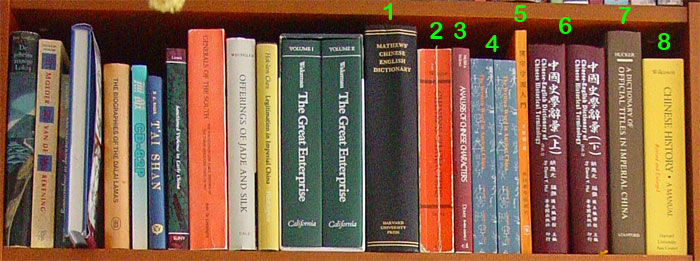
1. Mathews' Chinese-English Dictionary
2. Chinese Characters
3. Analysis of Chinese Characters
4. The Written Word in Ancient China
5. The Origins of Chinese Characters
6. Chinese-English dictionary of Chinese historical terminology
7. A Dictionary of Official Titles in Imperial China
8. Chinese History: A Manual, Revised and Enlarged
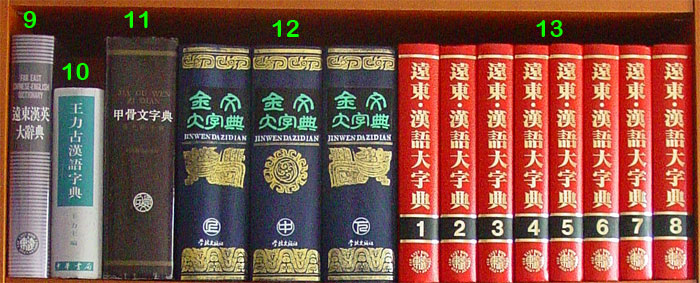
9. Far East Chinese-English Dictionary
10. 王力古漢語字典
11. 甲骨文字典
12. 金文大字典
13. 漢語大字典
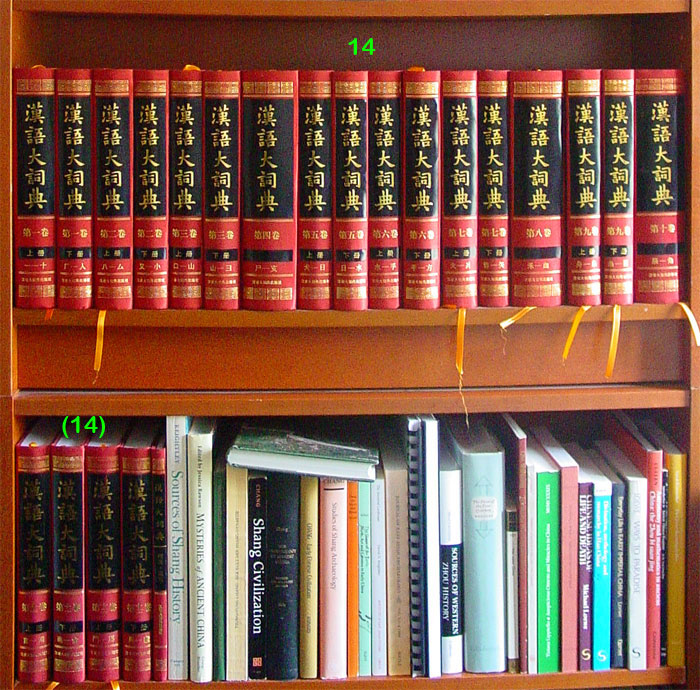
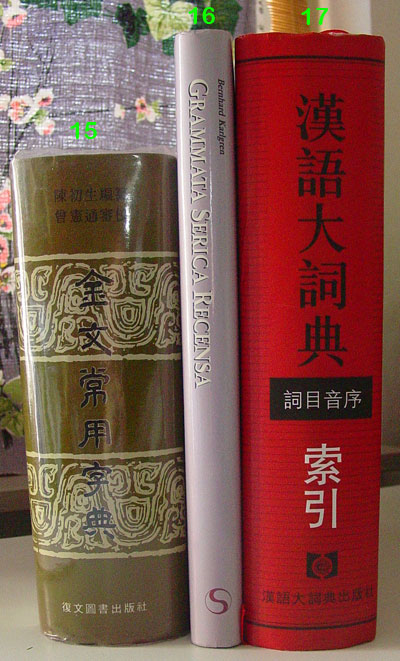
15. 金文常用字典
16. Grammata Serica Recensa
17. 漢語大詞典詞目音序索引 (index to 14 - 漢語大詞典)
Thursday, 26 May 2005
Shanghai Museum Chujian Zhouyi
Books can make me happy, but the book I received today thrills me with excitement. I finally received a copy of the Chujian Zhouyi, aka the Shanghai Museum manuscript of the Zhouyi (to read more about it see Edward Shaughnessy, A First Reading of the Shanghai Museum Bamboo-Strip Manuscript of the Zhou Yi, forthcoming). It is the oldest (but not complete) copy of the Zhouyi we have today; it is estimated around 300 BC.
In the Spring of 2004 the Chujian Zhouyi was published. Shaughnessy writes about this book:
(...) this third volume is sumptuously produced. It begins with a two-part section of photographs of all the strips: first, half-size full-color photos of all of the strips arranged in what the editors believe was their original order, and then enlarged full-color photos in which each strip occupies a single page. This introductory section is then followed by an 83-page section of transcription and detailed commentary written by Pu Maozuo 濮茅左, a senior curator at the Shanghai Museum. As in earlier volumes, this section begins with a brief overview of the text, including its physical properties, format, general paleographic considerations, and, in this case, the place of the manuscript in the textual history of the Yi jing. This section proper consists of strip-by-strip presentations of the text. Also as in previous volumes, each strip is introduced by yet another photograph, this one full-size and black-and-white (though certain symbols that are red on the original strips seem to have been hand-colored in these photographs). There then comes a detailed description of the physical characteristics of the strip, including especially notation of any breaks and/or rejoinings. Finally comes a phrase-by-phrase discussion of the text on the strip, each of which is followed by how the phrase reads in the silk manuscript of the Yi jing that was discovered thirty years ago at Mawangdui 馬王堆, in Changsha 長沙, Hunan, and also how it reads in the received text. The presentation of the Zhou Yi includes also two appendices. The first, 35 pages long, is a line-by-line comparison of the Shanghai Museum manuscript, the silk manuscript from Mawangdui, and the received text of the Zhou Yi; entries for both the Shanghai Museum and Mawangdui manuscripts include both photos of the original manuscript and also direct kaishu 楷書 transcriptions. The second appendix, 10 pages long, is a study of six different black and/or red symbols that are included with each of the hexagram texts of the manuscripts. Publication of the volume was delayed apparently because of a flaw in the coloring of these symbols in the first print-run, necessitating the withdrawal and reprinting of the entire edition. This is a manifestation of the care that has gone into the editing and publication of all of the Shanghai Museum manuscripts. Although this volume, like most paleographic publications, has already met with various types of criticism, mainly from scholars in China, the scholarly world is surely much in the debt of all those who have worked so hard to make these manuscripts available.
The book measures 44 x 30 cm in size, the quality of the paper, printing and binding is excellent, in all, it is a pleasure to look at. I don't even dare to read it, afraid that I will spoil the pages!
The next few weeks I will examine the book and the manuscript carefully. If I find anything interesting (of course I will) I will let you know.
上海博物館藏戰國楚竹, Vol. 3
ISBN 7532530140
Below are some samples of pages.


Saturday, 14 May 2005
The banner of 'qian'


There are a lot of things you have to keep in mind when you investigate the character qian 乾 from hexagram 1. First, there is the problem of finding the right components which form the character. Your first impression would probably be that the character consists of the component  on the left side, and 乞 on the right side. This idea would probably be strengthened by the fact that there are more characters with as a component, like 朝 or
 . The last character was written in bronze inscriptions like this (金文大字典, p. 2517):

And if you link this old form to 乾 you might be inclined to think that is the sun among trees or something similar and use this finding in your interpretation of 乾. But is not a component in 乾, we have to add the top-right part of the character as well, which makes the complete component  (full form 倝). This is the true, and most meaningful part of the character 乾.
is often recognized as the earliest form of 乾. The online Dictionary of Character Variants gives variants of , including  , which according to the 漢語大字典 (p. 1529-1) is similar to
 (p. 2222-10), which is the same as 乾. Of course you have to be careful with using such detours, but it shows that is the significant part in 乾.
To find some meanings of this component the Shuowen 說文 surprisingly put me on the right track. I usually hesitate to use the Shuowen dictionary, because it often gives fancy descriptions that have nothing to do with the oldest form of a character. [27-05-2005 See about the reliability of the Shuowen (and Wieger's Chinese Characters) the entries by kentsuarez in this thread.] But in this case the Shuowen proved helpful. It says about 倝:
倝,日始出,光倝倝也。從旦, 聲.
'Qian, the sun starting to appear, its rays qianqian 倝倝. From 旦 'daybreak', as phonetic.'
The first part, 'the sun starting to appear, its rays qianqian' is an odd description of a character, and a Western dictionary would never get away with this. It is like defining the word 'walking' like "walking, the feet walkingwalking". But it should put you in the right direction: when the sun comes up the rays of the sun qianqian. Possibly this means that the rays of the sun get brighter and brighter, increasing its intensity while the sun is climbing higher.
At least two things in this sentence from the Shuowen are fascinating. First, the Shuowen speaks of qianqian 倝倝, and this reminds me of the only text in hexagram 1 where the character qian 乾 appears, namely line 3. Here it says
君子終日乾乾.
'The junzi all day long qianqian.'
Here we have the character 乾 repeated, just like 倝 in the Shuowen. This doubling of the character, and its place in the sentence, suggests that 乾 is a verb, the doubling also suggests continuity or intensity: it goes on and on. Richard Kunst says about this reduplication:
There is such a pronounced tendency in both the Shijing and the Yijing to describe junzi with one or another reduplicated expression that we may define the pattern "junzi X-X" or "X-X junzi" as a literary device, a kind of an epithet for the nobility.(The original "Yijing", p. 397)
With the description from the Shuowen in mind, we get the picture of a junzi who works on his position all day long, extending the rays of his influence.
A nice interpretation, but there is another interesting fact in the sentence from the Shuowen. It says "聲", meaning " as phonetic". This is odd, because is clearly different from . Is the Shuowen suggesting that is the same as ?
 On oracle bones and bronzes is written like this (漢語大字典, p. 2174-1; picture on the right is after 楊英杰, "先秦旗幟考釋", Wenwu, 2 (1986): p. 52-56, as mentioned in James C.H. Hsu, The Written Word in Ancient China, p. 878; Wang Hongyuan 王宏源, The Origins of Chinese Characters ("漢字源入門"), p. 155):

The banner was very important in ancient times. The place where the banner was set up indicated the place where the tribe was stationed. The banner was often raised high in the air, so that everyone could see it, and usually accompanied the commander into battle (...). The people of many tribes built their villages in the shape of a square or a circle in order to emphasize the fact that they were of the same blood and shared community and defensive concerns. Yangshao culture villages were constructed on this pattern. All the houses in a circular village faced inwards towards the large building used for gatherings which was built in the centre. The banner was usually set up near it. Therefore, the oracle bone graph(modern character zhong 中 "center", "middle") shows a place marked with a pole, which may or may not have had banners attached to it
, indicating a certain area with a banner pole at the centre. In some oracle bone inscriptions there are divinations made by the king in which he asks whether there will be a strong wind on the day when he establishes "the centre", no doubt the place where the banner would be set up. From this we know how important the place was where the banner was set up and that this practice strongly reflected earlier tribal organization. (p. 838)
Drawing of a pole with some decorative streamers. The pole was placed in the center of a circle or dial so that a shadow cast by the sun on a calibrated dial could measure solar time - much like the gnomon or style of a sundial. (Wang Hongyuan 王宏源, The Origins of Chinese Characters ("漢字源入門"), p. 195)
This sundial principle reminds us of the sun 日 part of the component , as already mentioned in the Shuowen. There is a resemblance between and ; we might surmise that they share a common origin which points to banners. [18-05-2005 James Hsu confirms in a personal e-mail that 乾 might be related to a sundial.] Whatever path you choose, the meaning of banners in seems unavoidable. This is even more the case when we look at the old forms of . On bronzes the character is written like this (漢語大字典, p. 169-4):

The big 金文大字典 dictionary gives a lot of interesting information about 倝 (p. 5430). It quotes Xu Zhongshu 徐中舒 (1898—1991), the late expert on oracle bones inscriptions, who says that 倝 is the original character of 韓 (also written as 𩏑) and 榦. In bronze inscriptions 榦 has the meaning of 'to support' (金文常用字典, p. 615-616). 韓 was the name of a feudal state around 1100 BC. which bordered the Western Zhou region and had to pay tribute to the Zhou. Ode M261 from the 詩經 is devoted to this state. A feudal state brings and receives support. But 韓 and 榦 also share a common meaning, namely that of 'railing of a well'. A railing is some kind of border. I mention this because it comes in handy later.
The 金文大字典 also brings to our attention an oracle bone character which has to do with banners & support:

Three men are supporting a banner. In all instances that are found of this character the pole (in Chinese also described with 榦) has shapes like  ,
 ,
 or
 . These might be the precursors of the component
 in the bronze form of 倝.
In other words, gone is the meaning of 'The 日 sun rising behind the trees of the jungle', as Karlgren says (Analytic Dictionary of Chinese and Sino-Japanese, 299; quoted in Wenlin). and are pictures of banners, and if we want to find a meaning of 乾 we have to take this into account. This idea of a banner or flag in 乾 is already mentioned by Hellmut Wilhelm, who writes in his Sinn des I Ging:
The primary element in this character appears to be radical 62 (戈), which represents a flag pole. In the old writing it was depicted by a planted halberd with a yak's tail fluttering from it. It was the symbol of the commanding authority in the army. To this primary element two meaning additions ("Bedeutungszusätze") were added. The first is the word for 'sun', but not the sun as a heavenly body but as a light giver, a word we also find in the character yang 陽, one of the main principles in ancient Chinese philosophy. The second meaning addition is the character for 'water'. (p. 40)
In a footnote Hellmut thanks his colleague Erwin Reifler for his help in the analysis of the character. Reifler's studies of Chinese characters are not entirely undisputed, to say the least, but in this case he seems to be quite right, even if he regards as 戈, a character which in its old form is close to the old form of .
 But there is another character which has a remarkable resemblance with the bronze form of . The character 岸 looks very similar, in its modern form, but also in its old form. It has several meanings, but the ones that are of interest here are (漢語大字典, p. 766-4)
- raised land that borders a river, lake or see (靠江、河、湖、海等水邊的高地)
- boundary (邊際)
- same as 犴, village prison (鄉間牢獄)
- metaphor for a high position (比喻商位)
These meanings are similar to that of 韓 and 榦, which share the meaning 'railing of a well'. The character 岸 adds to this a high position, as James C. Hsu said, "the banner was often raised high in the air, so that everyone could see it".
There is another thing which connects all the characters I have mentioned so far: they are all close in pronunciation, which might point to their common origin, the component :
| 乾 倝 㫃 韓 榦 岸 | gan/qian gan yan han gan an |
I do not have the proper sources to check how the pronunciation was round 1000 BC, and there is a big chance that it was different in that time. Nevertheless it is remarkable that today all the characters have at least the same final (weiyin 尾音).
Having said all this, it is difficult to come to a conclusion about the meaning of 乾 in line 3 of hexagram 1. My personal guess is that line 3 is a lamentation of a junzi: he always has to be worried about his position and how he can be of support to the king, and can get support in return. This explanation will probably not satisfy you and might even be dissapointing after this detailed exposé, but it is not my style to come with elaborated wild assumptions which are not 100% percent backed up by facts. And facts, well, they are hard to get in this field.
Wednesday, 20 April 2005
The misconceptions of Robert G. Benson
"I am highly critical of almost all popular I Ching books available today. My successes using the I Ching, and the dismal state of this area of knowledge, have compelled me to produce this book. (...) recent research leads to the conclusion that no translation can accurately represent what the I Ching truly is. None of the I Ching books currently on the market shows how the I Ching is actually a comprehensive philosophical statement about how our lives undergo change. Perhaps even worse, none are an effective practical guide to using the I Ching. I wrote this book to say what hasn't been said before. I wanted this book to open new doors -- to be a breakthrough book for novice users, but to also be filled with critical insights for experienced users".
I have not bought his book, nor do I intend to. After all, when a writer states that none of the Yi books currently on the market "are an effective practical guide to using the I Ching", he is definitely not up to date with this field of study, and that makes me lose all interest in his work (see also Hilary Barrett's point of view). But that is not my major concern here. A writer can write what he wants, as long as it is backed up by facts or reasonable arguments. But more than thirty years of studying (who knows what) does Benson make false statements about a subject he is obviously not very familiar with:
A Warning about "Astrology of the I Ching"
There are a few websites which contain computerized versions of Shao Yung's Astrology of the I Ching. The information for these comes from two published work by Chu and Sherrill (in The Astrology of I Ching and An Anthology of I Ching). I have done extensive research into this system and inspected it in both these sources. This is indeed a remarkable system, but unfortunately I've found that there are two "transmitted errors" in one of the key tables. (I use this term because the error is egregious, and clearly cannot come from the originators, who were experts in the I Ching). Using this table UNCORRECTED means that the system CANNOT EVER give answers using hexagrams 30, 38, 49, and 58, and will give incorrect answers SOMETIMES using hexagrams 10, 13, 14, 17, 19, 21, 22, 28, 31, 35, 36, 37, 41, 43, 45, 47, 50, 54, 55, 56, 60, 61, 63, and 64. Thus, 28 of the 64 hexagrams (44% by number) are being incorrectly or inconsistently reported! I have communicated this fact to authors of some of these programs, but I have no knowlege if they've researched this, or used the correction (which I've published in a footnote in my book). This fact is very significant, because these programs cost money, and yet are worthless. Also, unfortunately both Chu and Sherrill are deceased. Therefore, I DO NOT recommend using ANY programs based on Chu and Sherrills materials for the "Astrology" system unless this correction has been applied to that table. As always, caveat emptor (buyer beware)!
His statement contains several errors. First, although a lot of divinatory systems (including Meihua Yishu, plum blossom numerology) are attributed to Shao Yong, none of them are to be found in Shao's work. The attributions are apocryphal. But this is a minor error.
What is worse is that he claims there is an error in table 13 of Chu & Sherrill's Astrology of I Ching, 'The earthly numbers and trigrams' (as said in e-mail correspondence). You need this table to calculate one of the two trigrams that make up your 'birth hexagram'. In this table there are the even numbers 2 to 60, and each number is assigned a trigram. 2 = Earth, 4 = Wind, 6 = Heaven, 8 = Mountain, 10 = Water, etc. Number 20 and 50 are also assigned the trigram Earth.
And that, says Benson, is wrong. They should have the trigrams Lake and Fire, he says. He wrote in an e-mail to me how he found out about this error: he calculated the hexagram of a person, and the outcome was.....wrong. And because he found the answer was wrong, the system had also to be wrong.
That is odd. How could the answer be 'wrong' when it is only a hexagram you get and which you have to interpretate? A hexagram can hardly be called 'wrong', the only trouble you may have is with the interpretation. It is possible you may not understand the answer. Also, by now millions Chinese have used this system with satisfaction. Also in the West many find the system does work and gives accurate results. They are able to work with the answers they get, but at some point Benson was not. Does that make the system 'wrong'?
But the table in S&C's book is not wrong. The original Heluo Lishu document contains no table, but rules for the calculation of the Earth trigram. The table in the book is based on these rules (in this order):
- If the Earth number is larger than 30, substract 30. If it is still larger than 30, again substract 30.
- If the Earth Number can be divided by ten, discard the zero.
- If the Earth number is larger than 10, substract 10.
S&C put these rules in a simple table. Let's try these rules with the numbers 20 & 50. 20 can be divided by ten, therefore we discard the zero. The result is number 2. For number 50 we substract 30, which leaves 20. We discard the zero, which leaves 2.
To find the corresponding trigram you have to look at the houtian trigram circle combined with the Luoshu (see this image). Number two corresponds with the trigram Earth. In other words, the table in S&C's book is correct.
Benson also says "Using this table UNCORRECTED means that the system CANNOT EVER give answers using hexagrams 30, 38, 49, and 58, and will give incorrect answers SOMETIMES using hexagrams 10, 13, 14, 17, 19, 21, 22, 28, 31, 35, 36, 37, 41, 43, 45, 47, 50, 54, 55, 56, 60, 61, 63, and 64". This is not quite true. It is true that it is impossible to get hexagram 30 and 58. That is not a flaw in the system, it is simply the consequence of the rules because the calculations for the Earth trigrams only use even numbers, and the trigrams Fire and Lake have numbers 7 and 9. It is impossible to get 7 and 9 as final outcome of the Earth trigram calculations, and the consequence is that you can never get hexagram 30 and 58. But it is a consequence with a reason behind it. Heluo Lishu deals with human matters, it tells about people's character and how they will function in society. Hexagram 30 deals with Knowledge & Wisdom: according to the Chinese vision nobody is born with K&W, you have to acquire it during your life. The same goes for hexagram 58: Happiness in its most essential and fulfilling form is something you have to learn, you do not get it on a silver plate when you are born (after all, being born is very traumatic, that's when the trouble starts). Hexagram 30 & 58 are impossible to get, but all the other hexagrams Benson mentions are possible as outcome.
It is easy to say that a table is wrong when you don't know the rules behind it. Instead of writing that the system (or a part of it) contains errors, just because he doesn't know or understand the background of it, Benson should better have checked his findings with someone who is acquainted with the original Chinese material.
Saturday, 16 April 2005
Doubt
In reply to an entry in Hilary's weblog:
Many who have been working with one translation for years often become confused when they see another translation which differs quite from theirs, but is more true to the original Chinese text. What to do? Still use your old book with which you were comfortable for all these years but which now has breaches in its outer layer of perfection? Or use the new translation which fits like new shoes - uncomfortable yet, but walking probably makes it better? If you choose the latter, how about all these years and the answers you got from your first book? Should the answers you got through all these years have been better if you used this new translation instead? Doubts arise.
But the problem is not the book, it is what you do with it. In the end it doesn't really matter if the book you use is close to the original Yi or not. If you value the book, if it enriches your life, if you draw inspiration from it, if it helps you and you are not concerned about the Yi and its history and origin - then what does it matter if it is THE Yi or something entirely different? As an ordinary user you shouldn't be bothered by questions about origin and originality - you should be selfish and think about your own concern only. If a new translation doesn't give you what you need, and you have walked all possible ways to comprehend it, then stop punishing yourself and use what you are familiar with.However, if it is important to you that you use a book which is as close to the original Yi as possible, in other words you want to use the Yi as an oracle and not any other book, then you will have to get used to using a new translation every now and then. You will have to learn to cope with doubts, and integrate them in your learning process.
"People who do not doubt simply have not devoted themselves to concrete practice. If they have concretely practiced, there must be some doubts. Something must be impractible, and that raises doubts. (...) The student must first of all know how to doubt. (...) Combine the internal and the external into one and regard things and the self as equal. This is the way to see the fundamenal point of the Way."
- Jin-si Lu: 'Reflections on things at hand'
Use doubt to your advantage. There is no difference between You and the book you use. After all, every book can be used as an oracle. What matters is how the book fits you. The Yi does not serve everybody.
Wednesday, 13 April 2005
Some observations

Guān 觀 consists of two parts: 雚 and 見. Most etymological dictionaries quote the Shuo Wen 說文 which says that 雚 represents the pronunciation 'guan', and that 見 gives the meaning 'look'. But according to the 甲骨文字典, 雚 is the precursor of 觀 (p. 979 and 408-409). It is more than a phonetic component, it definitely adds meaning to 觀.
雚 is rarely mentioned in Chinese texts, it mostly occurs as a component in other characters (觀, 權, 歡, 灌, 勸, 罐,顴 etc.). The Shuo Wen 說文 says that 雚 is a "小爵" (漢語大字典 4104.2), an ancient wine vessel with three legs and a loop handle. This seems to be correct, as Karlgren says about 爵: "Cup for libations or feasts; noble, nobility, dignity, rank -- cf. 尊; originally a picture, in the small seal altered so as to contain 鬯 aromatic herbs and 又 hand; now still more deformed; the cup had the form of a bird; 爵 and 雀 'small bird' are etymologically the same word, hence 爵 is sometimes used for 雀" (quoted in Wenlin). The fact that a 爵 had the shape of a bird, more specifically a heron, is significant here, because 雚 contains the component 隹 'bird'. (But I don't understand why Karlgren says that 爵 and 雀 are etymologically the same word, because according to the 甲骨文字典 their shapes are entirely different. But we will take that for granted.) The 吅 component in the character might represent the two knobs which are used to carry the vessel after the wine has been warmed. That 吅 can represent these knobs can be seen in the character 斝, which is also an ancient type of vessel which has these knobs (see here).
The 甲骨文字典 says that 雚 and 雈 (not to be confused with 萑) are exchangable. In oracle bone inscriptions 雈 can be the name of a sacrifice, the name of a place, of a person, or synonym to 觀 'look', or the same as 舊 'old'. Tsung Tung-Chang adds: "  (variants
 ) is identical to 雈 = an owl with feather horns (according to the Shuo Wen HM), (...) 雚 = 鸛 = 'ciconia boyciana'. In oracle bone inscriptions it is used for the homophone verbs 灌 = 'pour wine' and 觀 = 'look at'." (Der Kult der Shang-dynastie im Spiegel der Orakelinschriften, p. 65).
The chance that 觀 has something to do with offerings is enlarged by the Judgment of hexagram 20: 盥而不薦.有孚顒若. "Washing
the hands yet not sacrificing. Having captives (of war) looking up,
which is in order". This text deals with offerings and sacrifices.
But what is then the meaning of the component 見? If 雚 represents the wine vessel (covered up 艹 because it is not yet used?) for the libation or the libation itself (灌), then what does 見 add to it? It seems as if it refers to the persons who are not carrying out the sacrifice, but are viewing (見)
it. They are observers, and maybe their job was to look for omens which
might occur during the service, as a sign of the gods. They 'wash their
hands but do not sacrifice'. They only observe.
Hexagram 20 could describe different kinds of looking at the sacrifice, for instance, 童觀
in the first line could denote viewing the sacrifice from within a
barren field, or from the top of a mountain which has all the
vegetation cut down for a better view (for this meaning of 童 see 漢語大字典 2711.9).
Wednesday, 6 April 2005
The far place
 The character you 攸
already appears on the oracle bones from the Shang-dynasty (ca. 1750 -
1122 v. Chr.). As we see it know it referred to a specific place, city
or area (Jiaguwen Zidian 甲骨文字典,
p. 336). According to my historical Atlas it was a area in the current
region of the Fei Huang river, in the North of the province Jiangsu (see map).
However, when it comes to the Shang dynasty historical atlases are not
always reliable, after all there is no material at hand which says
'this place was there', which makes filling in the Shang map a bunch of
guesses.
 On bronze inscriptions from the Zhou-dynasty (ca. 1122 - 221 BC) the
character also often occurs, mostly in two meanings. One meaning
doesn't seem to be of interest to us, because in this case it is always
used in combination with le 勒.
It seems to refer to the bronze ring which kept the reigns of horses
together. But this meaning only goes for this specific combination of
characters, and we don't find this in the Yi. The meaning which is of
interest to us is that of 'long (ago)', or 'far (in distance)'. On
bronze inscriptions the character is often a synonym for xiu 修 or you 悠,
and if you look closely you will see resemblances between the
characters. If a character got more meanings in the course of time,
making it difficult to understand which meaning was meant in a text, to
add an extra component which pointed to the meaning the writer
intended. On the Zhongshan Wang Ding 中山王鼎 tripod from the Zhanguo-period (481 - 221 BC), which was found in 1977, we find the character with the meaning of 'far'. We also know texts where you 悠 with the meaning of 'far' is written as you 攸 (Jinwen Da Zidian 金文大字典 p. 430).
I suspect there is a connection between the Shang meaning of you 攸 and the Zhou meaning of you 攸. During the Shang dynasty it was a specific location, somewhat far from the (last) capital (see map, no. 1 is the last Shang capital), but not too far (about 300 kilometres). The Zhou capital however was far more to the West (no. 2), and much further from the You 攸 area - about 700 kilometres, assuming the historical atlas is right. Maybe you 攸 in the time of the Zhou did not refer to the location You anymore, but was used more general in the sense of 'far away'. The Yi is supposed to be written during the Zhou dynasty, so maybe in the Yi you 攸 also means 'far'. Let's see what this gives us.
In the Judgment of hexagram 2 we read: 君子有攸往. Wilhelm says "If the superior man undertakes something...", Huang says, "Superior person has somewhere to go", Boering says "The student can undertake something". But if we translate you 攸 as 'far', then a (somewhat literal) translation would be: "The Junzi has far to go", in which we can see you 有 with a little enforcement, like 'must' or 'sensible, good to'. You 攸 seems to refer to the areas far from the capital, the outer regions at the border of the land that was under control of the Zhou. This assumption seems to be confimred by The Judgment of hexagram 3, where it says 勿用有攸往. 利建侯: "not execute/use far travels, (more) favourable (is it) to appoint feudal lords". In this case it seems better for the king to leave the far regions to helpers who do the work for him.
As said the character you 攸 appears 32 times in the Yi. Within these 32 instances we can discern 5 patterns:
1. 利有攸往: 24-0, (25-2,) 26-3, 28-0, 32-0, 41-0, 41-6, 42-0, 43-0, 45-0, 57-0, 22-0
2. 無攸利: 4-3, 19-3, 25-6, 27-3, 32-1, 34-6, (37-2,) 45-3, 54-0, 54-6, 64-0
3. 有攸往: (2-0,) 14-2, 36-1, 40-0, 44-1
4. 不利有攸往: 23-0, 25-0
5. 勿用有攸往: 3-0, 33-1
I see youwang 攸往 here as a journey to the borders of the empire. Wang means as much as "commence a journey" (Jinwen Changyong Zidian 金文常用字典; p. 197). In the bronze version of this character we find the component wang 王,
'king'. Normally it is said that this component represents the
pronunciation, but in my view it could also point to the meaning: it is
the king who goes.
The examples below give the idea that it is only good to undertake a youwang when at the home front everything is in order.
Pattern 1: 利有攸往
"Favourable to have a youwang".
For example
26-3: 良馬逐。利艱貞。曰閑輿衛。利有攸往。"A
chase with good horses. Favourable to have a hard times divination. It
is said, use chariots as blockade for defence. Favourable to have a youwang."
Jian 艱 means 'hard, difficult times' (金文常用字典; p. 1097, Jiaguwen Zidian 甲骨文字典; p. 1464). A divination was not only done to know what would happen, but mainly to decide what would happen. It was an arrangements with your forefathers. You take care of their wellbeing by bringing offerings, they make sure there will not take place any calamities. This is also found in an additional meaning of jian 艱: mourning about the death of (one of) your parents (Hanyu Da Zidian 漢語大字典;
p. 3171). After their death your parents are capable of sending you
luck or disaster, therefore you have to be assured of their support.
A
'hard times divination' could be used in difficult times (or after the
death of a parent) to get the support of the ancestors. With that
support, and with good material, it can be favourable to have a youwang.
Pattern 2: 無攸利
"No profit from the you". From the border regions comes no profit.
For example
4-3: 勿用取女。見金夫。不有躬。無攸利。"Do not use 'taking the woman'. The bronze worker has to be seen. Do nothing personal. From the border regions comes no profit."
Qu 取 mostly means 'take, appropriate'. In Shang it was probably also the name of a offer ritual (甲骨文字典; p. 292). That would make a 取女 a woman who is being offered, probably to get something. In bronze inscriptions was qu 取 Also een shortening for zou 郰, the name of a city (金文常用字典; p. 292). This would make 取女 'a woman from Zou', but this is unlikely.
Tsung-Tung Chang says in Der Kult der Shang-Dynastie im Spiegel der Orakelinschriften about qu 取: " ist
identisch mit dem heutigen Zeichen 取. In Orakelinschriften hat es,
außer der heute üblichen Bedeuting "nehmen", auch die Bedeutung
"Kulthandlung". Hsü Shen erklärte die Struktuur dieses Zeichens met dem
alten Brauch, das linke Ohr des erlegten Wildes oder des erschlagenen
Feindes als Trophäe abzuschneiden. Daher bin ich der Ansicht, daß
dieses Zeichen die Darbringung eines Ohrs als Symbopfer bedeutet." (p.
171)
勿用取女 also occurs in the Judgment of 44. It says there that the woman is zhuang 壯. Zhuang 壯 means 'strong, powerful', but earlier it also stood for the age of 30 years (漢語大字典; p. 428 ) . In the Li Ji 禮記 we read: "人生十年曰幼學,二十日弱冠,三十曰壯,有室."
"In a human life the ago from 10 years on is called 'studying child',
from 20 years 'young (but) with hat' (=adult HM), from 30 years zhuang 壯, this is 'marry'." An man was expected to marry when he was about thirty, a woman when she was about twenty or preferably sooner. A woman who was zhuang 壯 was too old to 'take', to marry.
見金夫: jin 金 is metal, but was in Zhou time mostly used for 'bronze' (金文常用字典; p. 1111). Fu 夫 is a craftsman, a soldier, a bureaucrat, or someone who does manual labour (漢語大字典; p. 521).
不有躬: bu you 不有 literally means 'not have', but in the Yi this is expressed with wu 無. Bu you 不 seems te be a verb, a action, instead of a condition: 'not be there'. Gong 躬 is 'body', but also 'personally', 'from/for yourself' (漢語大字典; p. 3808 ). Bu you gong 不有躬 could mean 'without body', but to me this sounds too weird.
The
situation is here in such a way that there can not be taken a wife.
This puts the survival of the family at risk. That is why first the
bronze works have to be in order (ritual objects, gifts for the
ancenstors). When this is not arranged you can not undertake anything.
The outer regions cannot be of service to you (for instance they cannot
serve you a wife).
Patroon 3: 有攸往
"Have a youwang". Have a journey to the border regions.
For instance
14-2: 大車以載。有攸往。無咎。
"A large wagon for transportation. Have a journey to the border regions. No misfortune (is being sent)."
Jiu 咎 means 'misfortune', 'blame', or 'punish the guilty' (漢語大字典; p. 608 ), but in Shang time it stood for 'misfortune sent from above' (甲骨文字典; p. 896). I found this adds a nice ring to it, that's why I kept it here. Beauty also has its merits.
Patroon 4: 不利有攸往
"No fortune in having a youwang". It is of no use to have a journey to the outer regions.
For instance
23-0: 剝.不利有攸往。"Stripped. No fortune in having a youwang".
Bo 剝
is 'too strip', 'cut in pieces', 'wear out', 'flake off', 'break down'.
These meanings have something of decay in them. Also: 'remove with
violent force' (漢語大字典; p. 346). In times of bo 剝 it is not profitable to have far travels. A youwang
was used for inspections, but also to impress, to show who is still in
power and control. But a king can only safely leave the home front when
all is in order there. In times of bo 剝 that is not the case.
Patroon 5: 勿用有攸往
"Do not use having a youwang". A youwang is not the right means here.
For instance
33-1: 遯尾.厲.勿用有攸往。"Withdrawal at the tail. Disaster. Do not use a youwang."
Wei 尾 was in Shang time probably the name of a feudal state ('方國名', 甲骨文字典; p. 945). The character from that time shows a man or animal with a tail, and 'tail' is therefore the common translation. But Wei 尾
also means 'the mating of animals', and that would make the translation
'withdrawal during mating'. Nice thinking, but probably we are dealing
here with a military action. Wei 尾 also means 'that which is not yet finished, the last part, that which hangs at the end' (漢語大字典; p. 967). This gives the impression that an army pulls back while the battle is not yet decided or won. Wei 尾
also means 'country border', which would make the translation
'withdrawal at the border'. Of course that is not good in a war.
Disaster!
Language
Huanying, huanying!
Many people (including me) have problems viewing the Chinese characters on my site. Even Firefox, which is the best browser for it, does not always do the job right. To help visitors viewing the articles I have converted some of them to pdf format, which can be viewed with Acrobat Reader. If you see this icon

at
the beginning of an article, you can view that article as a pdf by clicking on the icon.
Disadvantage of these pdfs is that you cannot click links, or images
for enlargement. So keep it alongside with the original web article and
you should do fine.
Categorieën
Zoeken
Add me to your blog, FB, Twitter...

